

A cornerstone of the brand’s range for decades, the Grand Cherokee combines Jeep’s off-road DNA with day-to-day appeal
For those of us who remember it well, the fact that 34 years have passed since the debut of the Jeep Grand Cherokee is a sobering thought, although it was way back in the early ’80s that the idea of a bigger Jeep was first considered. The aim was to give this famous 4×4 brand a more prestigious model than the Cherokee, which made sense thanks to foreign rivals like the Toyota Land Cruiser and Range Rover being pushed further upmarket. But with Jeep still being under AMC ownership at that time, it was a brand that struggled to gain serious investment.
It wasn’t that AMC didn’t want a new Jeep. In fact, the company had commissioned various outside designers (including Italy’s Giorgetto Giugiaro) as well as its own in-house team to come up with proposals for a new, bigger Jeep. But asking for sketches and clay models from designers is one thing; funding the production go-ahead of an entirely new vehicle is another.
In fact, it wasn’t until Chrysler took on ownership of Jeep in 1987 that resources could finally be devoted to additional product lines, which would include a bigger, more luxurious model – a vehicle that existing Jeep owners could upgrade to when they came to change, as well as being good enough to attract newcomers to the marque. Development took time, but finally the new Grand Cherokee was ready for launch by 1992 – immediately attracting praise from Jeep enthusiasts and the motoring press alike.
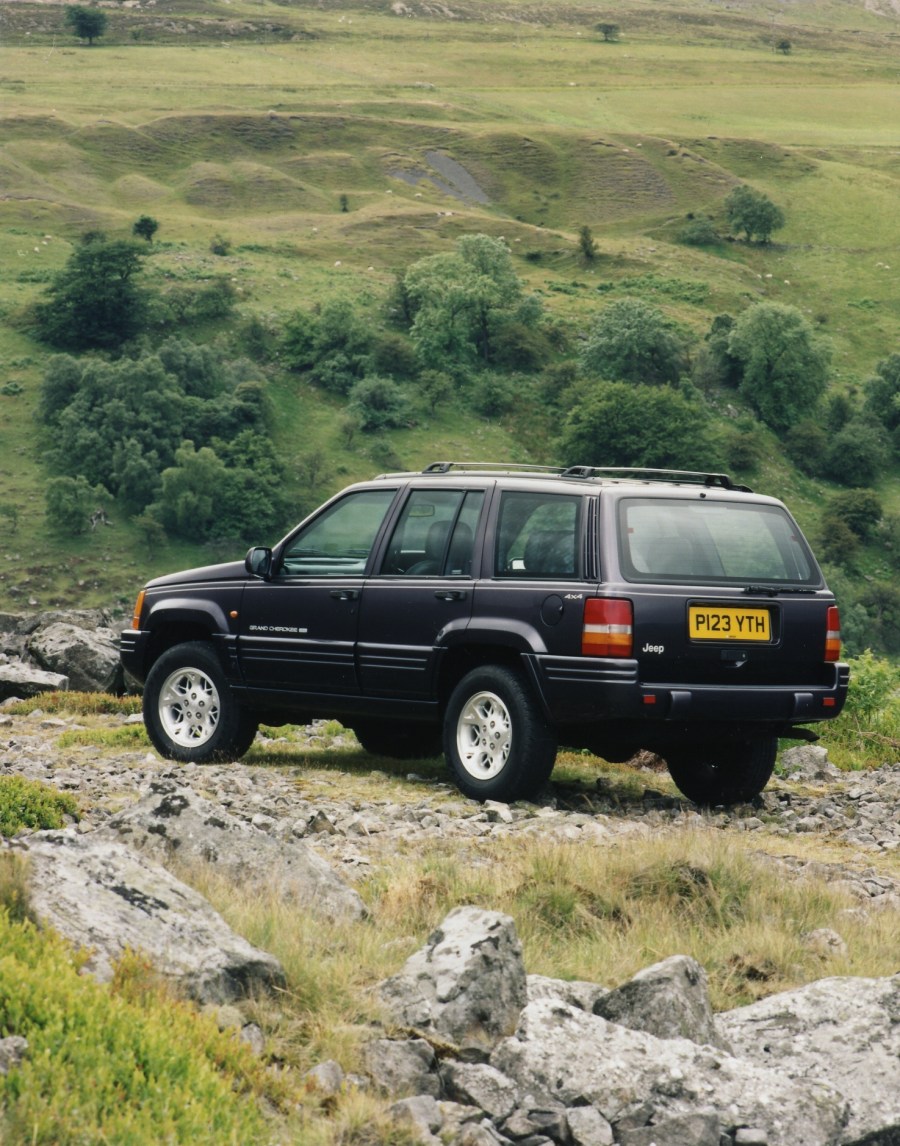
First generation: ZJ
What set the Grand Cherokee apart from crucial rivals like the relatively new Ford Explorer was its monocoque construction, giving it a more sophisticated on-road feel than the traditional separate-chassis approach used elsewhere. And yet the newcomer promised to retain the off-road prowess buyers had come to expect from any Jeep, aided by a choice of Command-Trac (part-time), Selec-Trac (part-time that could be switched to full-time) and Quadra-Trac 4×4 set-ups, the latter offering permanent all-wheel drive. In each case, the Grand Cherokee driver could select low-ratio gearing via the dual-range transfer box, giving the big Jeep real ability when the going got tough.
What sat under the bonnet was also a matter of choice, with a 2.5-litre four-pot, 4.0-litre straight-six and 5.0- and 5.7-litre V8s available in the US market during the first-generation’s 1992-98 career. When the Grand Cherokee finally went on sale in the UK in ’94, the only powerplant on offer was the 4.0, though this would be joined later by the Cherokee’s 2.5-litre turbo-diesel, as well as 5.2- and 5.9-litre V8s for the real petrolhead buyer.
The Grand Cherokee was, of course, a major hit around the world – not least here in Britain, where the Jeep brand had only recently been reintroduced. The motoring press loved the idea of a big, well-equipped SUV at class-leading prices, with What Car? magazine claiming that the Grand Cherokee’s value for money “puts the skids under the Range Rover”.
Second generation: WJ
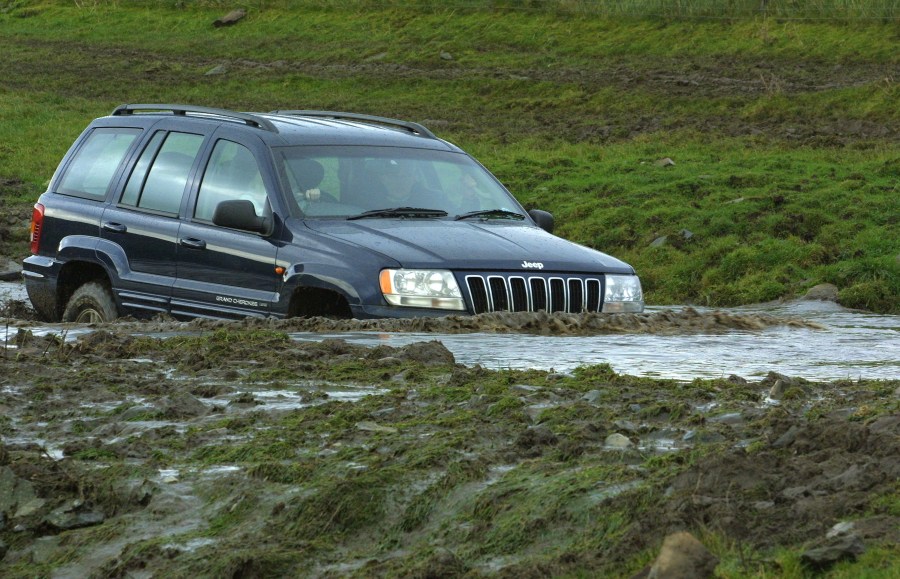
Nothing stays the same forever, and the Grand Cherokee was no exception. By the late 1990s, the 4×4 game had moved on and Jeep needed to stay ahead. The result was a new, second generation of Grand Cherokee – the WJ-series – which took a bow in 1999 and went on sale in the UK shortly afterwards.
The most obvious difference was in its styling, despite being evolutionary rather than revolutionary. It succeeded in bringing the Grand Cherokee’s image bang up to date, thanks to its smoother, sleeker lines, yet wasn’t so drastic as to scare the traditionalists. Under the skin, though, the changes went further.
The old pushrod V8s were replaced by a new PowerTech 4.7-litre V8, while the 4.0-litre straight-six was also upgraded – both engines available in the UK with high-spec Limited trim. Later in 1999, a 3.1-litre five-cylinder turbo-diesel arrived, with – like the petrol versions – automatic-only transmission. And what about four-wheel drive? Two systems were offered, the standard set-up being Quadra-Trac II, which used a hydraulically-activated clutch to transfer torque front to rear.
Normal running saw all drive diverted rearwards, with it gradually sent to the front wheels when loss of traction was detected. It could also be used in 4-Lo guise, which locked the front and rear axles together, as well as employing low-range gearing. Optional, however, on all Grand Cherokees – but standard on the V8 – was Quadra-Drive, which was fully automatic and allowed torque to be split not only front to rear but also between individual wheels.
The 3.1-litre diesel was only to last two years, for in September 2001 a new 2.7-litre CRD arrived, using a five-cylinder engine with variable geometry turbo, supplied via Mercedes-Benz. This was shared with the Mercedes ML, and instantly became the Jeep Grand Cherokee of choice for most British buyers of the time. It was also much more fuel efficient than the old 3.1-litre, with CO2 emissions of 257g/km giving it a significant advantage over both that engine and the two petrols.
Third generation: WK
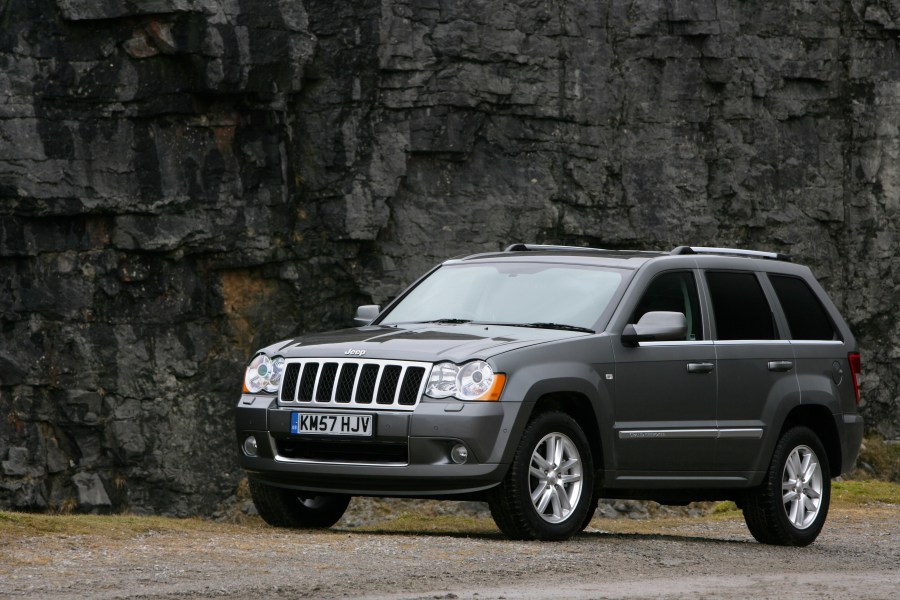
By the time the ‘MkIII’ version was ready for launch in 2004 (arriving in Britain the following year), the Grand Cherokee was firmly established among buyers of premium SUVs, its combination of high equipment levels and value for money winning it many friends – despite talk of poor reliability in some instances. So, surely the new WK-series would build still further on this?
Well, no. Okay, there were improvements made to the Grand Cherokee’s noise and refinement levels, and its styling was successfully updated via a slightly lower stance, smart new ‘quad’ headlamps and a generally sportier look. And, of course, it was still good value for money, with prices starting at less than £30,000. But for journalists of the time, that simply wasn’t enough.
Autocar magazine was particularly critical, naming and shaming the third-generation Grand Cherokee as the worst car it had driven all year – a unanimous vote among its testers. The magazine went on to describe the Jeep as “crude, cramped, overpriced and over here”, even suggesting that had its “mediocrity not [been] so prejudicial to its creator’s health, it would have been laughable”. But was it really so bad? Other testers were less scathing, with What Car? praising the WK’s equipment levels, off-road ability and value for money, although the magazine did go on to criticise the relatively cramped cabin and high running costs.
Engines were a high point, however, with the 3.0-litre V6 diesel proving the mainstay of the range, while the 4.7- and 5.7-litre V8s were the enthusiast’s highlight. But what if you wanted even more power? Then the SRT8 was the Grand Cherokee for you, complete with 420bhp, 6.1-litre Hemi V8, a 0-60mph time of 4.6 seconds and a derestricted top speed of 170mph. Fewer than 12,000 SRT8s were built in total, and it was always a scarce sight in the UK. But for anyone who craved an SUV that was faster than most German super-saloons and more exclusive than an Italian supercar, it was certainly a tempting choice.
Fourth generation: WK2
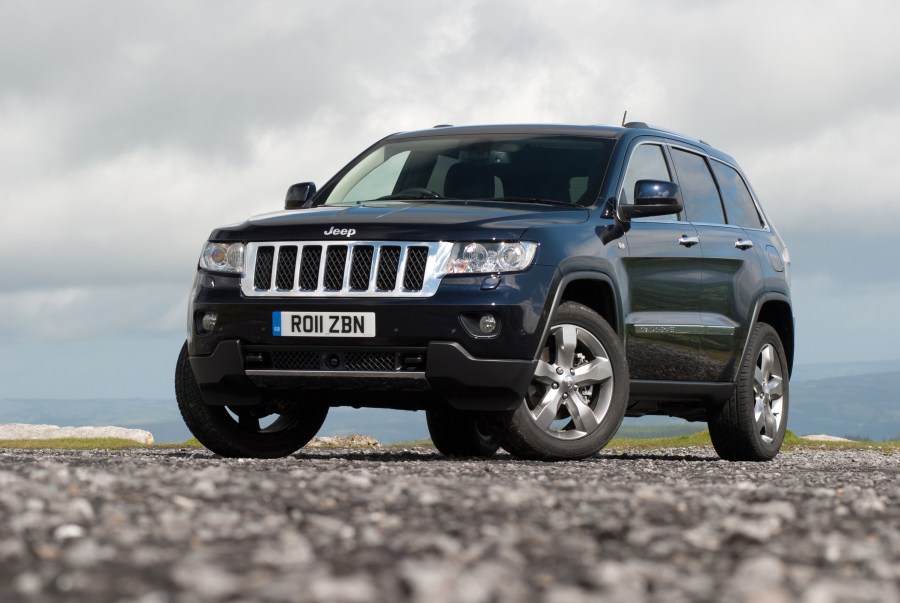
With the product code WK2, you might have expected the fourth-gen Grand Cherokee to be little more than a revised version of the WK that had gone before… but you’d have been wrong. In fact, the WK2 that went on sale in the USA in 2010 and arrived in the UK the following year was a totally new design, enabling parent company Chrysler to answer all previous criticisms of the WK.
The downside for UK buyers was that the latest Grand Cherokee was available only with a 2987cc V6 diesel engine – a unit shared by Chrysler and its new majority shareholder, Fiat. But lack of choice didn’t detract from the fact that this was a worthy engine, with the right combination of power (237bhp), torque (406lb.ft at 1800rpm) and economy (30mpg-plus overall) that buyers of large SUVs expected by then.
Just as importantly, this latest Grand Cherokee was 146 per cent more structurally rigid than the model before it, which meant massive improvements in NVH (noise, vibration, harshness) levels, as well as dramatically better on-road handling and off-road progress. In fact, so good was the latest Grand Cherokee (which was based around the platform of the next-generation Mercedes-Benz ML-series), Fiat Chrysler Automobiles planned to use it as the basis for a range of future SUVs from Alfa Romeo and Maserati – an announcement that might not have been of huge interest to American car fans of the time, but at least showed how far the Grand Cherokee had come in terms of its competitiveness.
It’s just a shame that British fans of the Grand Cherokee could only look on in envy as Jeep’s home-market buyers were offered 5.7- and 6.4-litre petrol-engined versions of the WK2. Yes, the SRT8 was back, this time with a monstrous 465bhp on tap and performance to match.
Fifth generation: WL
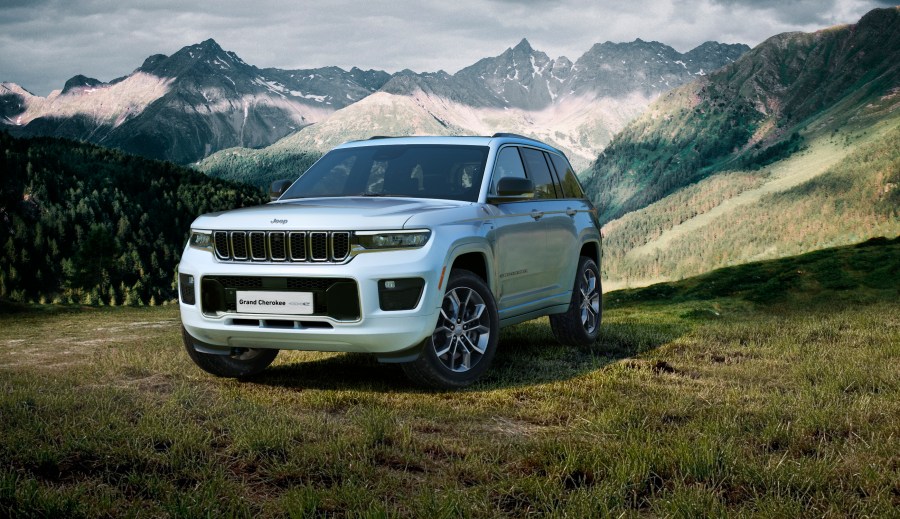
The latest WL generation debuted in January 2021 via the all-new Grand Cherokee L, the first in the long-running line to have three rows of seating as standard and available in a choice of six different trim levels: Laredo, Altitude, Limited, Overland, Summit, and Summit Reserve. It was followed by the two-row version eight months later, offering the same trim choices but with the addition of the off-road-focused Trailhawk.
Both versions have a choice of three different four-wheel drive systems comprising Quadra-Trac I, Quadra-Trac II featuring low range, and Quadra Trac II with Electronic Limited Slip Differential (ELSD) and Quadra Lift air suspension – the latter enabling the latest models to cope with up to 24 inches of water. A 3.6-litre Pentastar petrol V6 is available in the US market, producing 290bhp and 257lb.ft of torque, while Overland and Summit models boast 357bhp and 390lb.ft of torque thanks to their standard 5.7-litre Hemi V8.
The WL generation is also the first Grand Cherokee to be available as a plug-in hybrid (PHEV), badged as the 4Xe – and it’s this version that remains the sole offering currently on sale in the UK. Sold in a choice of Limited or Summit Spec here, priced from around £72,500, the 4Xe features a 2.0-litre turbocharged four-cylinder petrol engine combined with an electric motor for a total output of around 380bhp, with up to 30 miles of electric-only running available. It’s all a far cry from the raw appeal of an earlier V8 version, but at least the Grand Cherokee lives on in this age of electrification – even if its UK presence is now far more ‘niche’ than before.