

We chart the short but brilliant career of one of Ford’s all-time greats: the first-generation Thunderbird
Words: Richard Heseltine Images: Ford
Success is often attributed to good fortune, but this was patently not the case with the Ford Thunderbird. It was the right product at the right time, and one that surfed the zeitgeist to the point that punters clamoured to land one. It may not have been a technical tour de force, but it had style to spare. It was well reasoned, thoughtfully designed and expertly marketed. And as such, it outsold its arch-rival, the Chevrolet Corvette, by a factor of 23-to-one during its first year on sale. Let that sink in for a moment. Like the Mustang that followed in its wake, the Thunderbird was an instant classic and one that cast the longest of shadows over subsequent iterations.
You could argue that none of the ensuing generations of Thunderbird quite lived up to the original… but then how could they? It was created during a period of starry-eyed futurism; when the USA was literally and figuratively shooting for the stars. The word iconic is bandied about with monotonous regularity, much of the meaning having been dulled through overuse, but the first-series Thunderbird really was an icon of its time. Just don’t call it a sports car. Contrary to much that has been written about the first generation over the years, it never was particularly sporting, which isn’t to say that it wasn’t fast. For its day, it was. And how.
It’s worth recalling that Henry Ford II had form when it came to two-seater roadsters, having collaborated with Italian minnow Cisitalia on a sports car powered by a Mercury V8 unit. Then there was the Vega, a pretty one-off that packed a flathead unit and styling by Vince Gardner. The Thunderbird, by contrast, was never meant to be built in small series, nor was it to have European overtones; not even trace elements. As to the precise narrative behind how it came into being, it rather depends on whose estimates you credit, but its creation was unquestionably influenced by the Corvette. Nevertheless, its origins stretch back even further.
While Henry Ford II was clearly interested in sporting fare, it could be argued that Lewis Crusoe deserves much of the credit, with the former General Motors man helping midwife the car into being. According to popular rumour, he and designer George Walker were walking around the Paris Motor Show in 1951 when they spied a sports car, the identity of the marque depending on who is telling the story. Crusoe pointed to the car and enquired as to why Ford didn’t make something like it. Walker replied that that a roadster along similar lines was already in the works, but what it was remains unclear.
Chances are, no such scheme existed. It was pure flim-flam, but Walker sensed an opportunity. Legend has it that he telephoned senior styling czar Frank Hershey and told him about his chat with Crusoe, the upshot being that Hershey immediately set about creating a design study. Crusoe saw a painted clay mock-up in May 1953, which bore a close resemblance to what would in time become the Thunderbird. Henry Ford II then gave his blessing and pitched the (as yet unnamed) car against the Corvette, which had been first seen in January of that year. Anything General Motors can do, Ford could do better and all that.
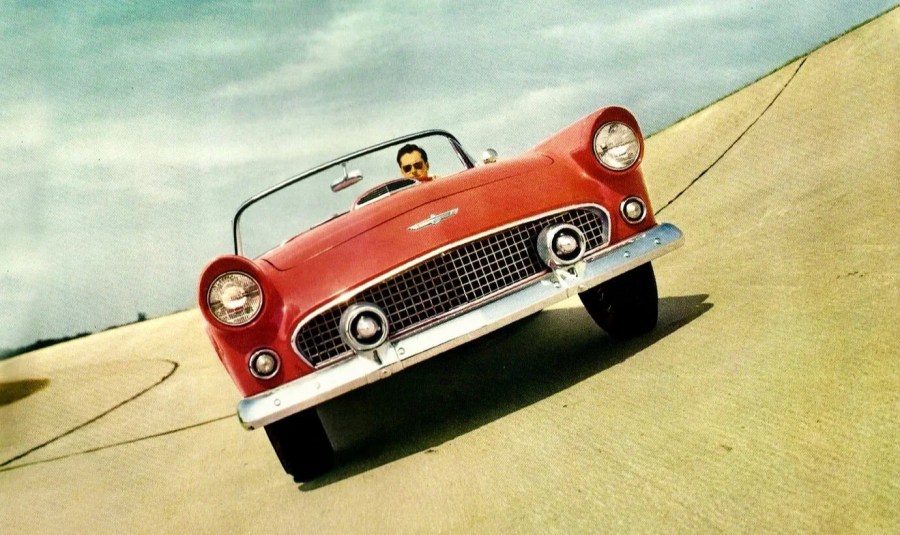
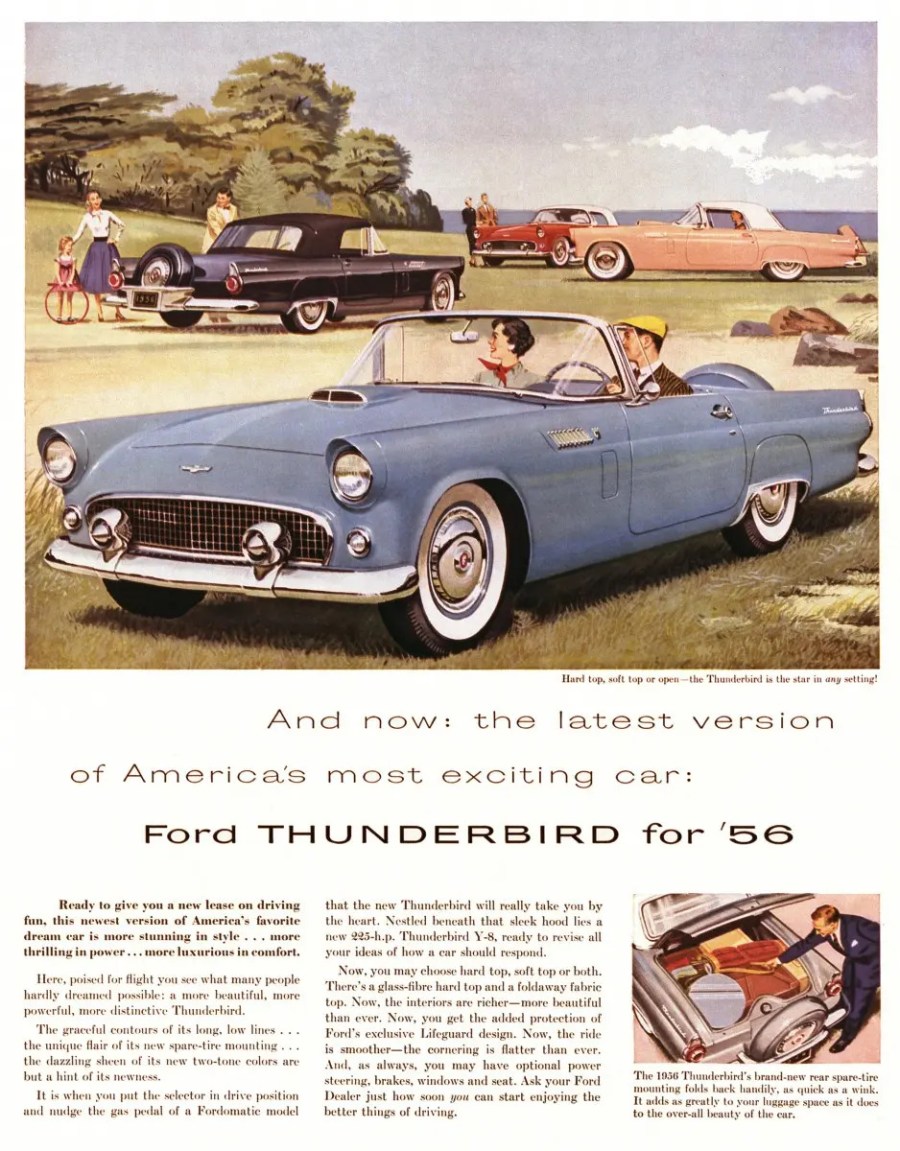
Ultimately, much of the styling was the work of William P Boyer Jnr, a 20-something designer poached from GM by Hershey in 1952. The design was diametrically opposed to the Corvette’s rounded form and more highfalutin offerings from Europe. Yes, there were the classic long nose and short(ish) boot proportions, but the outline here was rectilinear. There were reference points – visual signifiers – to other cars in the model range, not least the hooded headlights and vestigial tailfins, the end result being a car that looked like a regular Ford convertible that had been chopped ’n’ channelled, shortened and generally reconfigured.
Even those predisposed to disliking American styling trends had to admit that it looked sensational. Nor was it cramped and leaky, unlike many of its Continental rivals. The cabin was generously proportioned and suitably glitzy, complete with a bench seat that could accommodate three abreast. There was just the small matter of a name. Inevitably, multiple monikers were suggested and batted away, including Apache, Eagle, Thunderbolt and Falcon, before a junior stylist suggested Thunderbird after a creature of Native American mythology.
The Thunderbird was first seen in prototype form at the Detroit Auto Show in February 1954. It caused a furore (some sources insist that Ford took 10,000 deposits before the event was over, but they may have been more akin to ‘expressions of interest’). It was officially launched in definitive form in September of that year, with production commencing a months later for the 1955 model year. Ford promoted the Thunderbird as being a ‘personal car’, which in European parlance translated as a ‘tourer’.
Underpinning the car’s steel body was a decidedly unexotic design of chassis that nevertheless worked appreciably well. It was a box-section affair with additional cross-bracing. The front end was suspended by a coil-springs and wishbones set-up, with a live axle and leaf springs arrangement being employed out back. Power came from Ford’s recently introduced overhead-valve 292cu.in Y-block V8 that produced 193 or 198bhp at 4400rpm depending on which transmission was specified (a manual and a Ford-O-Matic auto ’box were both available).
Such was demand for the Thunderbird, magazines struggled to get hold of cars to evaluate, with even Road & Track being forced to purloin one from a customer. It ended up appraising (thrashing) a car that already had 2500 miles under its wheels – one that Ford’s PR department borrowed back ahead of the test, with ace turner Clay Smith being tasked with ‘optimising’ its performance. The magazine reported: “General impressions regarding the T-bird are most favourable. The Ford Motor Company refrains from calling this car a sports car, but we think this policy is being overly cautious. Even the diehard sports car fan will admit that the natural evolution of the type has gone somewhat beyond the purist’s definition of a car suitable for both every day and competition driving.”
Road & Track tended to be a mite sniffy about homegrown fare. It criticised the Thunderbird’s optional power steering (2.6 turns lock-to-lock) and the speedo, which underread. It also found wind noise to be excessive. Nevertheless, the feature was mostly glowing, and concluded by stating: “Summed-up, the Ford Thunderbird at $2695 is terrific value. Our choice would be a ‘bare’ model equipped with a 3.73 axle with a three-speed manual transmission without overdrive [the test car had a three-speed auto arrangement]. If only Ford would offer a good four-speed close-ratio ’box, it would be worth $100 extra. They might even sell a few thousand to Ford sedan buyers.”
One thing Ford did not have was trouble selling cars, with 16,155 being shifted during the first 12 months. The engine displacement was raised to 312cu.in for 1957, which translated to 225bhp at 4600rpm in manual form.
Even the oft-starchy UK title, The Autocar, was mostly won over after it borrowed a car from British concessionaire, Lincoln Cars of Middlesex, before embarking on a road trip to Belgium. “The lines of the Thunderbird are simple but striking, marred only by the exterior mounting of the spare wheel and the unhappy porthole [in the optional glassfibre hardtop]”, it insisted.
The unheralded reporter went on to add: “Every car tester asks himself first just what the model is supposed to be, and for what type of market it is intended to cater. The Ford answer is that the Thunderbird is a fast touring car combining speed with luxury; that it is not a sports car or a sports-racing car. But when familiarity with the model grows, one cannot help feeling that the two-seater tourer description is a tongue-in-cheek line on the part of the manufacturer. For the Thunderbird will reach a true 100mph in less than 32 seconds with plenty still in hand.”
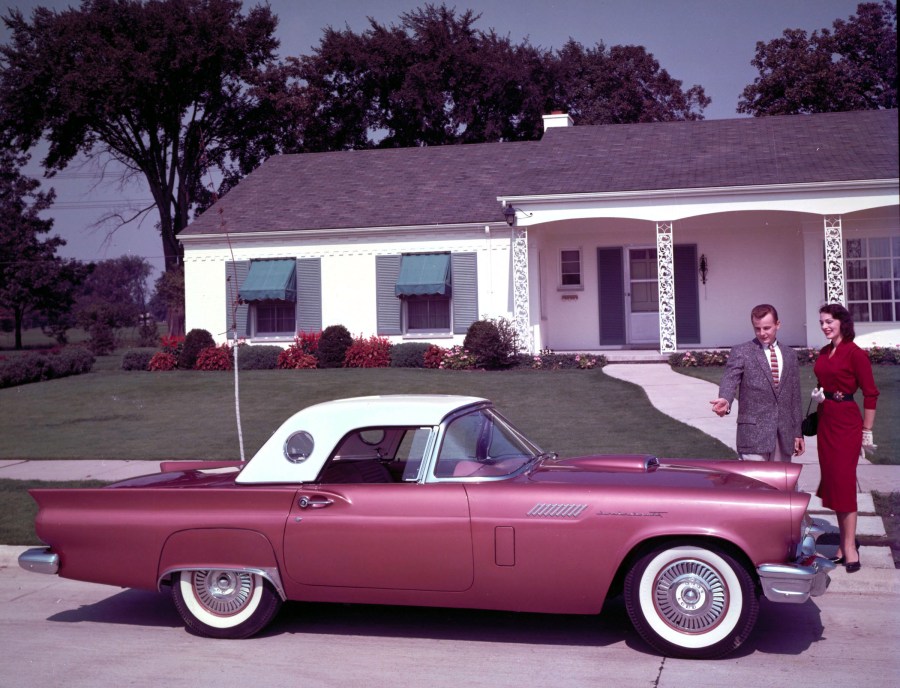
Priced at £3115 including purchase tax and import duties, it wasn’t a cheap proposition in Britain. That equated to Aston Martin money. Even so, The Autocar concluded: “The Thunderbird has arrived as a pleasant surprise, there being a great deal to be said for the clever compromise between comfort and very high performance indeed.” There were some significant changes for the 1957 model, too, including larger bumpers (with exhaust ports in the rear items), a chintzier grille and more pronounced tailfins. There were umpteen permutations of the small-block V8 with power outputs ranging from 245 to close on 300bhp with the optional Paxton supercharger; and in that latter form, the Thunderbird was good for 0-60mph in 9.5 seconds and a top end of 115mph.
As an aside, while a fast cruiser rather than out and out sports car, that didn’t stop the Thunderbird from appearing in competition. Ford collaborated with Peter DePaolo Engineering of Long Beach, California, on the ‘Battlebirds’, which comprised highly-modified underpinnings, engines spanning small- and big-block V8s, partially hand-formed aluminium bodies, and a lot more besides. One starred during the 1957 running of Daytona Speed Week, recording a one-way run at 204mph. Sister cars took to the circuits with varying degrees of success, one of them being closer in appearance to a regular Thunderbird (so no head-fairing), with variations on the theme continuing to appear as late as 1960.
The 1955-57 production models had proved a success, comfortably outselling the Corvette. However, while ‘America’s Only Sports Car’ underwent a high-performance makeover, the Thunderbird wandered off in a different direction. Senior Ford personnel were convinced that serious volume lay with a four-seater model. And as such, the 1958 edition – aka the ‘Squarebird’ – was absolutely, categorically, not sporting. It was considerably bigger and much heavier than the previous iteration, yet proved to be another massive hit during its three-year lifespan, to the point that around 200,000 units were shifted. Ford’s gamble was the correct one.
Nevertheless, it’s the first generation Thunderbirds that are remembered most. They aren’t just cars, they are cultural artefacts. They inspired popular songs and movies, and were driven by the central protagonists in TV shows decades down the line. There’s a reason why Ford chose the original design for its retro retread in 2002 rather than, say, a 1968 version. It may not have been a brilliant car, but the first-generation Thunderbird was a great one. It’s a subtle distinction, but an important one all the same.