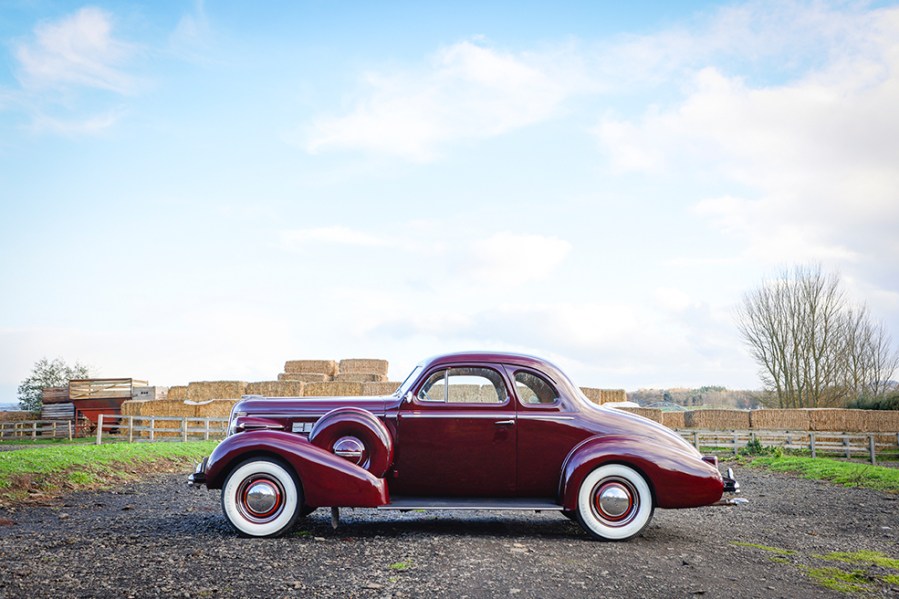


This spotless 1937 Buick did not arrive in Scotland from America, which means there’s an interesting history behind the stylish pre-war coupe
Words: Nigel Boothman Images: Lewis Houghton
If you fancy owning an American car and you live in the UK, there’s an obvious place to look for one – and it isn’t South Africa. But then Alex Holme’s route towards ownership of this 1937 Buick Special Series 40 Sports Coupe was anything but direct, as he explains: “I’ve always loved the cars, the history and the style of the Art Deco period and saw this Buick advertised in South Africa around 15 years ago. Although I wanted to buy it, we had young children and no time or money for something like that. Still, I kept an eye on the advert, and the car sat around unsold for some time before disappearing.”
Alex didn’t really think much more about the Buick until it came back on the market three years ago, and he just happened to notice. Maybe he had one eye on the South African small ads after all.
“I showed the advert to my wife,” says Alex, “and she said, ‘Are you mad?’ or words to that effect. But I wasn’t totally put off and somehow found it necessary to visit South Africa on business. I went to see the car in a place called Sedgefield on the Garden Route near Port Elizabeth, and of course I bought it.”
There followed all the hassles of export and import, getting police certification in South Africa to allow it to leave, and amongst other delays, a tedious glitch with the DVLA in the UK. “This car was built in South Africa from a CKD – or Complete Knock-Down – kit by the local General Motors assembly plant, which is why it’s right-hand drive,” says Alex. “But the DVLA didn’t seem to grasp this concept and wouldn’t accept it was a so-called year-original car from a proper factory.”
Luckily, Alex was able to call on the help of the American Auto Club UK, which made the position clear and the car’s registration duly followed. Thus, in 2024, Alex’s Buick relocated some 8000 miles north of its previous home to Edinburgh. So, what had he acquired?
The Special, as Buick fans will know, was the name carried by the least costly Buick line. Above it came the Century (Series 60), the Roadmaster (Series 80) and the Limited (Series 90), which grew in engine output and wheelbase. As you’d expect, each line was offered in a variety of body styles – variation on the limousine theme for the 90, sedans and a Phaeton (four-door convertible) for the 80, two- and four-door sedans and a Convertible Coupe for the 60, and also this Sport Coupe shared with the 40. The Special series offered the largest choice, with all the bodies already mentioned plus a rumble-seat convertible and a Business Coupe – really a Sport Coupe without the folding back seats, of which we’ll learn more in a moment.
The car’s previous owner in South Africa was Michael Roumanoff, who bought it in 1996 and enjoyed many years of success in vintage tours of up to 2000km as well as winning a 900km-long timed event called the Milligan Vintage Trial, not once but three times. Mr Roumanoff had the cylinder head rebuilt with hardened valve seats in 1998 and had some paintwork to the boot area and wings in 2005, but otherwise just kept it in tip-top condition with an annual service and oil change.
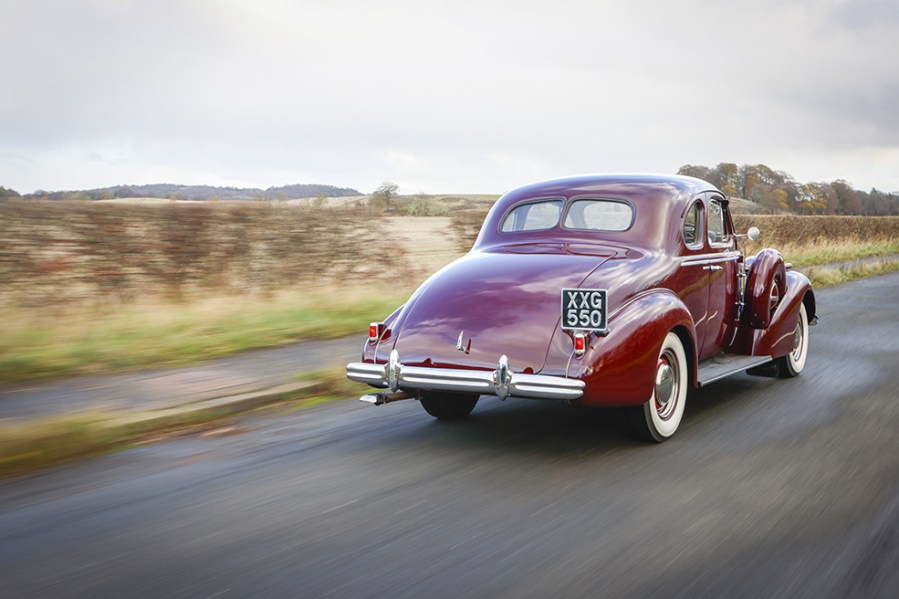
Prior to Mr Roumanoff’s ownership, a guy called Johann Venter had restored the car in the early 1980s, and to concours condition; it took the prize for Best American Vehicle at an international concours competition in Johannesburg in 1986. Earlier than that, the history is murkier, but we know General Motors had been importing cars to South Africa as far back as 1913 and assembling them in Port Elizabeth from 1926. This car, then, may have spent the majority of its life within a couple of hundred miles of its birthplace.
After only a couple of minutes on the road in this charming Buick, you start to see just how different American cars of the 1930s (wherever they were assembled) were from those created here – and it doesn’t flatter the Brits.
There are a few key points. American motorists weren’t taxed in the same way that we were, and so large, relaxed engines were much more commonplace. All but the most expensive American limousines were fitted with mass-produced, pressed-steel bodies like Fisher’s ‘Turret Top’ construction used on Buicks of this era, while in Britain hand-built, ash-framed coachwork still held sway; and while artisanal coachwork is lovely, it’s harder to keep it stiff and silent over the bumps, so ironically it’s the mass-produced approach that often gave a more refined experience for occupants. And by 1935, independent front suspension was becoming commonplace in the USA, appearing even on some Chevrolet lines, while most British cars – especially the more affordable ones – were still bouncing along on beam front axles and leaf springs.
Here, we sit on top of a well-stuffed bench seat on a relatively high-riding chassis, quite softly suspended and rolling on tall crossply tyres. While this makes for a forgiving ride over imperfect surfaces, it does allow the car to roll and plunge a little in corners. It’s mild enough, though, compared to the wallowing feel of the softest 1950s land yachts, which sometimes had another 1500lb of weight to manage. For the era, the Buick’s compromise of ride quality and stability is particularly good, and you certainly notice the lack of crash or scuttle-shake over potholes. Indeed, if you took a blindfolded passenger for a ride around the block and then asked them to guess the age of the car, they’d be picking a date 20 years younger than the truth, or even more.
You could interpret that a couple of ways. American cars might have evolved rapidly in terms of styling and power output after the war, but they remained dynamically stuck around 1940 for a long time. Perhaps a better way to view it is that by 1940, they were the standard of the world (Cadillac’s old slogan) across almost all price points.
Take the engine. The Series 40 used a straight-eight overhead-valve unit of 248cu.in (4.1 litres), producing 100bhp at peak and an abundance of torque, with 196lb.ft at just 2000rpm, most of which seems to be available just off idle. Hence only three gears are required: first is low and left on the lever, then up and right to second, then down to third. Once moving, you’d only ever use second and third, so it makes sense to have them in the same plane, where it’s easy to swish between the two thanks to excellent synchromesh. Braking comes from four 12-inch drums and while they won’t stand the car on its nose, they’re effective enough for the narrow tyres to be the limiting factor, as long as you have a strong right leg.
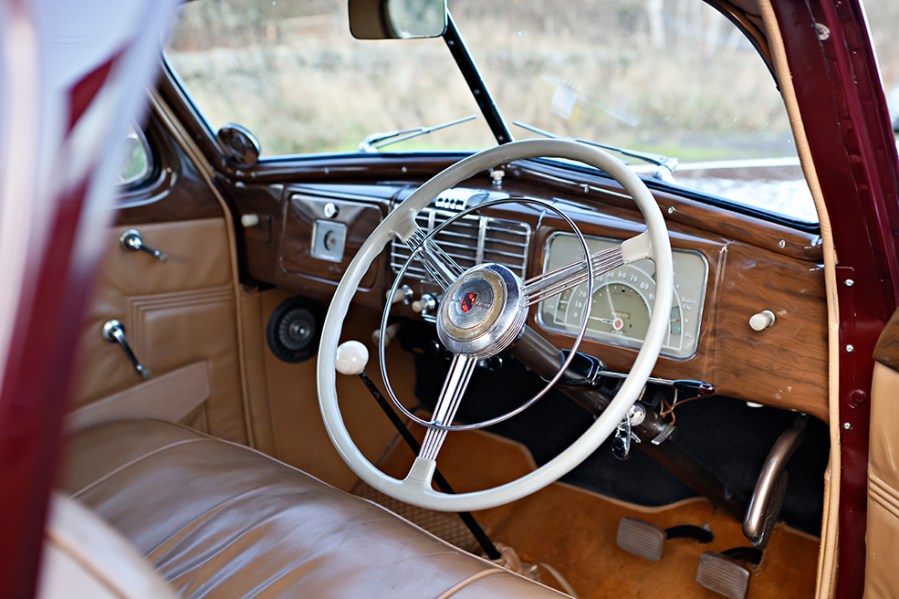
Perhaps the steering is one area where American products like this Buick were not quite as handy as good British equivalents. It has to be very low-geared to overcome the weight of the eight-cylinder engine, steel construction and independent front suspension, and the aim was for luxurious ease rather than sporting feel. Chrysler’s industry-leading introduction of power steering was still 14 years in the future when this car was built, so if you’ve driven a manual-steered American classic of any age, you’ll know the wheel-twirling required to get into a parking space.
At A-road speeds, the Buick suffers from a bit of wind noise, but the fact we’re even noticing this on a 1930s car shows how relaxing it is to ride in. Alex says it sits happily at 60mph on the motorway, even if you do have to leave a big gap for braking distances. It’s certainly more at home on the open road – or wide, straight American streets – than in Edinburgh city driving, but that’s only the slow steering and restricted visibility of the coupe’s body. It never grumbles, stalls or overheats, feeling docile at all times.
The Buick’s interior is a delightful mix of Art Deco detail and restraint. The clean, classy look of the dash and that marvellous speedo with temperature, oil level, fuel and amps in subsidiary dials is a joy to behold. There’s a built-in Delco radio in the symmetrical centre arrangement, currently out of use while a 1970s-ish Telerad radio-cassette hangs beneath. Reviving the original valve-driven unit, perhaps with modifications to allow DAB or music streaming from a phone, is on the cards.
Behind the front bench are the so-called opera seats. This is a clever and effective solution for a body shape like this coupe; and because such shapes disappeared by the end of the 1940s, it’s not a feature you see often. Cushioned pads are located on the panels behind each door and two little seat squabs fold down, allowing two people to sit cross-wise, leaning back and deciding whose legs go left and whose go right. Perhaps not ideal for an eight-hour journey across the Badlands, but perfect for a ride back from the opera, hence the name. Alex has had four adults in the car without complaints.
So, what impressions are we left with? This car is big for a coupe, with a footprint about the same as a modern medium-large SUV, but perhaps this is ideal. After all, it allows for an excellent blend of features: a snug coupe feel in the cabin but with usable rear seats, a huge boot, a nice ‘big car’ ride and less of the unwieldiness of a full-size Detroit automobile on UK roads. Most of all, though, it’s the ‘wow’ factor: the Buick’s stunning condition, lovely colour and strikingly elegant shape see to that. When you know what a capable, enjoyable car it is to drive, there’s no mystery about Alex’s pursuit of this lovely machine to the other end of the Earth.